Summary:
October comes fast in New York County. One week you’re running air conditioning, the next you’re fielding tenant complaints about cold offices. If your heating system hasn’t been serviced before that shift happens, you’re already behind — and in New York County, being behind has real consequences.
NYC law requires building owners to provide heat starting October 1. That’s not a suggestion. And the cost of an emergency repair during a January cold snap — when every HVAC technician in the city is slammed — is a completely different number than a scheduled fall tune-up. This guide covers what proper fall preparation looks like, when to start, and what to watch for in New York County’s specific building environment.
Heating System Maintenance Timing for New York County Commercial Buildings
The window most commercial building managers miss is late August through mid-September. That’s the sweet spot — warm enough that you’re not yet in heating demand, but close enough to the season that any parts you need can be ordered and installed before the first cold snap arrives.
Waiting until October is a gamble. Technician schedules fill up fast as the season turns, and if an inspection uncovers a failing component, a two-week parts backorder can put you in violation of the NYC Heat Ordinance before you’ve had a chance to fix anything. Getting ahead of the deadline isn’t just smart — in New York County, it’s the only approach that actually works.
What Does an HVAC Tune Up Actually Cover for Commercial Properties?
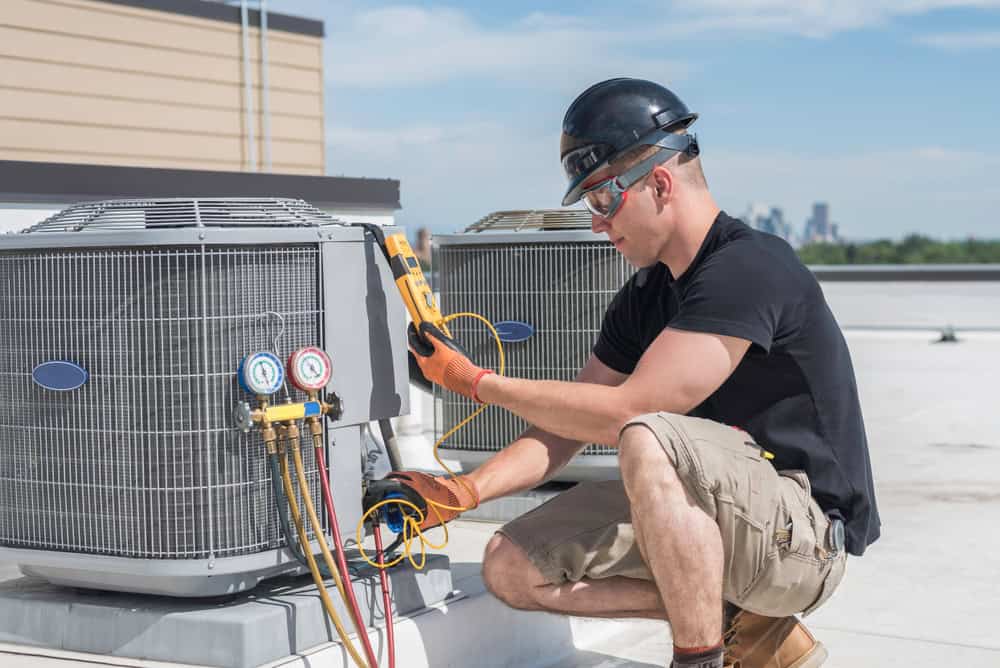
A professional fall HVAC tune up is more than swapping out a filter. For commercial buildings — especially the mix of pre-war, mid-century, and modern construction that defines New York County’s building stock — a thorough inspection covers a lot of ground.
The heat exchanger is one of the most critical checks. Cracks or deterioration here aren’t just an efficiency problem — they’re a safety issue, since a compromised exchanger can allow carbon monoxide to enter occupied spaces. Combustion chamber cleaning matters too. Soot and residue buildup forces the system to work harder and burns fuel less efficiently, which shows up directly on your energy bills.
Thermostat calibration is something that gets skipped more often than it should be. A thermostat that reads two degrees off in a large commercial building isn’t a minor inconvenience — it’s constant overcorrection, wasted energy, and tenant complaints. Ductwork should be checked for leaks as well, since leaky ducts can cause significant energy losses when maintenance is neglected across the system as a whole.
Lubrication of moving parts, gas pressure checks, drain pan inspections, and carbon monoxide detector testing round out a complete fall visit. In New York County buildings with PTAC units, Water Source Heat Pumps, or Fan Coil Units — which are extremely common in hotels, residential towers, and healthcare facilities throughout the region — each system type has its own specific maintenance requirements that a generalist technician may not fully understand. That’s where system-specific experience makes a real difference.
The goal of all of this isn’t just to check boxes. It’s to go into the heating season knowing exactly what you’re working with, so nothing surprises you in February when you have no margin for error.
How New York County's Humidity Shift Affects Your HVAC Settings in Fall
New York County’s fall transition isn’t just a temperature change — it’s a humidity change, and that matters more than most building managers realize. Summers in the region are hot and humid. By November, the air inside a heated building can drop to uncomfortably dry levels, which affects tenant comfort, increases static electricity, and can damage sensitive equipment in office environments.
Fall maintenance is the right time to assess your humidification settings and make sure the system is configured for the heating season, not still running parameters set for summer cooling. Buildings with older HVAC infrastructure — and there are plenty of those in New York County, particularly in pre-war construction on the Upper West Side, the Village, and throughout Midtown — often have humidification controls that haven’t been recalibrated in years.
Getting the humidity balance right also has a direct impact on energy efficiency. When indoor air is properly humidified, occupants feel warmer at lower thermostat settings, which reduces heating load. It’s a small adjustment with a measurable payoff.
For buildings subject to Local Law 97, that efficiency margin matters in a different way. LL97 places carbon intensity limits on buildings over 25,000 square feet, with fines of $268 per metric ton of CO₂ over the cap. In a large New York County commercial building, optimizing HVAC performance before the heating season — rather than letting an inefficient system run unchecked through the winter — is one of the most direct ways to manage that exposure. It’s not a substitute for a broader energy strategy, but it’s a lever that’s available right now, before the season starts.
Seasonal HVAC Maintenance Best Practices for New York County Properties
Commercial HVAC systems in New York County should be serviced at minimum twice a year — once before the cooling season and once before heating begins. High-demand buildings, healthcare facilities, and properties with older systems may need more frequent attention. Most commercial filters should be replaced every 30 to 90 days, with high-occupancy buildings or those near active construction sites requiring changes on the shorter end of that range.
The twice-yearly standard isn’t arbitrary. It reflects the reality that HVAC systems running at full capacity for months at a time accumulate wear, contamination, and minor inefficiencies that compound over time. Catching those issues in a scheduled visit costs a fraction of what they cost when they become failures.
Why Reactive HVAC Repairs Cost New York County Building Owners More
There’s a straightforward case for preventive maintenance that doesn’t require much convincing once you’ve lived through a January heating failure in a commercial building. Emergency HVAC service during peak winter demand comes at premium rates — and that’s before you factor in the cost of tenant disruption, potential lease violations, and the scramble to find parts for a system that’s already down.
Research from the National Institute of Standards and Technology found that planned maintenance programs reduce total maintenance costs by 50 percent compared to reactive, fix-it-when-it-breaks approaches. That’s not a marginal improvement — it’s half the cost, achieved simply by scheduling work before problems develop rather than after.
In New York County specifically, the math is compounded by density. A heating failure in a 30-story commercial building doesn’t affect one tenant — it affects hundreds of them, simultaneously, in one of the most tenant-competitive real estate markets in the world. The reputational and financial exposure of a winter breakdown in a Midtown office tower or a hotel on the Upper East Side is categorically different from a suburban property. The stakes justify the investment in preparation.
There’s also the parts availability question, which doesn’t get discussed enough. When a system fails in the middle of winter, the speed of repair depends entirely on whether the right parts are available. Buildings with older or specialized equipment — PTAC units, legacy boiler systems, discontinued WSHP models — can face extended downtime simply because the needed component is on backorder. That’s a problem that fall maintenance, combined with access to a supplier with deep inventory, can largely prevent.
What to Look for in a Commercial HVAC Maintenance Provider in New York County
Not every HVAC provider is equipped for New York County’s commercial building environment. The licensing requirement is the baseline — commercial HVAC work in New York City requires NYC Department of Buildings compliance, and building owners who use unlicensed contractors take on real liability exposure. That’s table stakes. The more meaningful differentiators are experience and parts access.
New York County’s building stock spans more than a century of construction. A technician who only knows modern systems will struggle with the PTAC installations in a 1960s hotel or the aging water source heat pump setup in a converted office building. System-specific knowledge — the kind that comes from decades of working across different equipment generations — is what separates a maintenance visit that actually prepares your building from one that just checks a box.
Parts access matters in a similar way. A provider who can diagnose a problem but can’t source the replacement component for two weeks hasn’t actually solved anything. We carry over 20,000 parts, including OEM and hard-to-find components, which means that when something turns up during a fall inspection, it gets fixed before the heating season starts — not after the first cold snap reveals the gap.
The consultation piece is worth mentioning too. A fall maintenance visit shouldn’t just be a technician running through a checklist. For commercial buildings — especially those with complex systems or multiple unit types — a real evaluation of your building’s HVAC condition and needs gives you information you can actually use. It tells you what’s in good shape, what needs attention now, and what to budget for in the next 12 to 24 months. That kind of clarity is harder to put a price on, but it’s what separates a vendor relationship from a useful one.
Getting Your New York County Building's HVAC Ready Before Winter Arrives
Fall HVAC system maintenance in New York County isn’t a nice-to-have — it’s the difference between a heating season that runs smoothly and one that costs you significantly more than it should. The October 1 Heat Ordinance deadline is fixed. The cold snaps that follow are predictable. What’s in your control is whether your system is ready for them.
The right time to schedule is now, while technician availability is still reasonable and there’s time to address anything the inspection uncovers. Waiting until the season turns means competing for limited service slots and absorbing whatever emergency rates come with them.
If you manage a commercial property in New York County and want a real assessment of where your heating system stands heading into winter, we’ve been doing exactly this kind of work for over 50 years. Reach out and let’s take a look before the season gets ahead of you.