Summary:
If you manage a commercial building in New York County, you’ve probably had this thought at least once: would it be easier to just ditch the PTAC units and go with central air? It’s a fair question — especially when a unit breaks down mid-July and you’re fielding complaints from tenants or guests.
But the answer isn’t as simple as “newer is better.” In New York County, the building stock, the costs, and the regulatory environment all factor into what actually makes sense. We walk you through the honest comparison — what PTAC repair involves, when it’s the smarter call, and what it would actually cost to go the other direction.
PTAC AC Repair: What It Covers and Why It's Often the Right Call
PTAC units are self-contained, through-wall systems that heat and cool individual rooms without any ductwork. That design is exactly why they dominate commercial buildings across New York County — hotels near Times Square, apartment towers on the Upper East Side, nursing facilities in Inwood, hospitals throughout the borough. Most of these buildings were constructed before central air was standard, and they weren’t built with the infrastructure to support it.
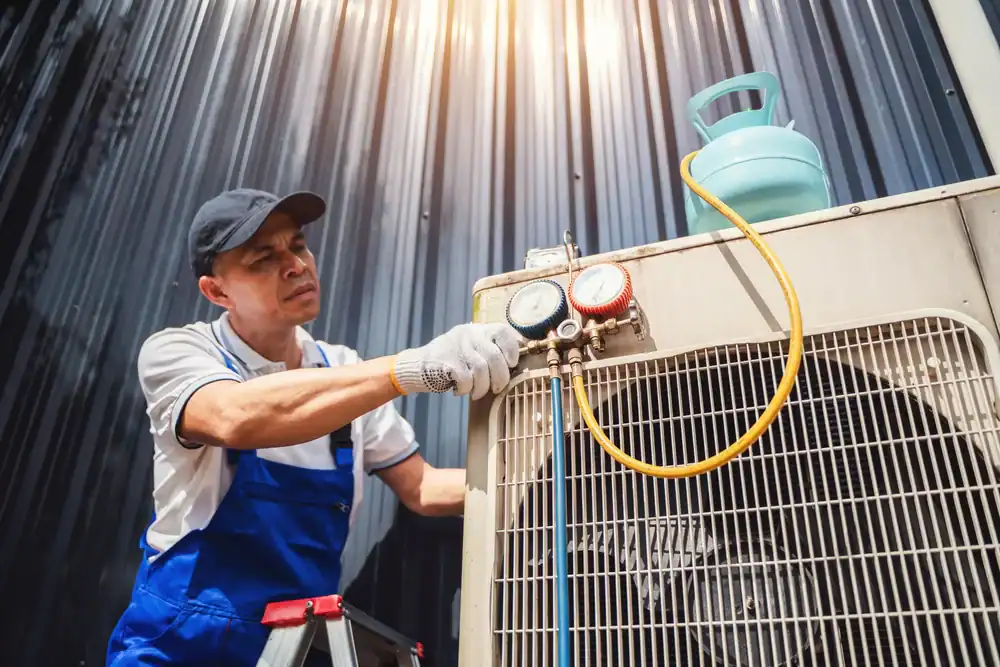
When something goes wrong with a PTAC unit, the repair path is usually faster and far less disruptive than people expect. Our qualified technicians can diagnose and fix most issues — a refrigerant problem, a failed control board, a dirty coil — without taking the room out of service for days. The key is working with someone who actually knows these systems and has the parts to back it up.
PTAC Air Conditioner Repair: The Most Common Problems and What Causes Them
The most common complaint we hear is a PTAC unit running but not cooling. The room feels warm, the unit sounds like it’s working, but nothing’s happening. Nine times out of ten, this comes down to one of three things: a dirty or clogged filter restricting airflow, a refrigerant charge that’s dropped below where it needs to be, or evaporator coils that are iced over or coated in grime. Any of these will kill cooling performance, and none of them require a new unit to fix.
Water leaks are the second most frequent call. If you’re seeing water pooling inside the room or running down the wall below the unit, the drain pan is usually the culprit — clogged with debris, algae, or both. Left alone, that moisture creates mold, damages walls, and eventually becomes a much bigger problem than a simple drain cleaning. In a New York County hotel or apartment building, that kind of damage compounds fast.
Noise complaints are their own category. A rattling or grinding unit in a hotel room is a guest satisfaction problem before it’s a mechanical one. Loose components, a failing fan motor, or debris caught in the blower wheel are the usual causes — all fixable, none catastrophic if caught early. The issue is that in busy commercial properties, these sounds get ignored until the unit stops working entirely.
Odors — musty or burning smells — tend to alarm people the most, and understandably so. A musty smell almost always points to mold growth in the drain pan or on the evaporator coil. A burning smell usually means dust on a heating element or, less commonly, an electrical issue. Both need attention, but neither automatically means the unit is done.
One thing worth knowing: older PTAC units from discontinued brands — McQuay, Singer, legacy GE and Carrier models — are still running in a significant number of New York County buildings. When parts for these units aren’t available through standard channels, most service companies default to recommending full replacement. That’s not always the right answer. We keep 20,000+ OEM parts in stock and our Smart Parts Team is specifically dedicated to sourcing hard-to-find components. If we can’t find the part, no one can — and that’s not a line we use lightly.
When Does PTAC Repair Stop Making Financial Sense?
The repair-vs-replace question comes up constantly, and the honest answer depends on a few specific factors — not just the age of the unit. A PTAC that’s been well-maintained can realistically last 10 to 12 years, sometimes longer. One that’s been neglected might show serious problems at year six. Age alone isn’t the deciding factor.
The general threshold most experienced technicians use: if the repair cost is approaching 50% of what a new unit would cost, replacement is usually the better investment. A new PTAC unit runs roughly $500 to $1,500 depending on the brand and BTU output, plus installation. If you’re looking at a $600 repair on a unit that’s already 11 years old and has had two previous service calls in the last two years, the math starts pointing toward replacement.
That said, there are scenarios where repair is clearly the right call even on older units. If the unit is structurally sound and the issue is isolated — a failed control board, a refrigerant recharge, a coil cleaning — repair makes sense. Especially when the alternative is sourcing a new unit, scheduling installation, and potentially dealing with sleeve compatibility issues in an older wall opening. In New York County’s pre-war buildings, wall sleeve dimensions don’t always match modern standard sizing, which adds cost and complexity to any replacement job.
The other factor people overlook is parts authenticity. A repair done with OEM parts — components sourced directly from the original manufacturer — performs differently than one done with aftermarket substitutes. Aftermarket parts can void warranties and often don’t match the unit’s original tolerances, which means you may be back in the same situation within a year. Every repair we do uses OEM parts. That’s not a policy we bend on.
PTAC Unit Maintenance: What Commercial Properties in New York County Should Be Doing
Most PTAC problems are preventable. That’s not a sales pitch — it’s just true. A unit that gets regular attention lasts longer, runs more efficiently, and costs less to operate. In New York County, where electricity rates run nearly 40% above the national average, the efficiency argument alone justifies a consistent maintenance schedule.
For commercial properties managing multiple units — a 150-room hotel in Midtown, a large residential building on the Upper West Side, a rehabilitation facility in East Harlem — the math compounds quickly. A well-maintained PTAC can reduce monthly energy costs by $30 to $60 per unit compared to a neglected one. Across 100 units, that’s real money every month.
How Often Should PTAC Units Be Serviced in a Commercial Building?
The short answer: more often than most building managers think. In a typical residential setting, quarterly filter cleaning might be sufficient. In New York County’s commercial environment — higher foot traffic, more particulate matter in the air, units running harder due to the urban heat island effect — monthly filter checks are the standard for hotels and high-occupancy residential buildings.
Evaporator coils should be cleaned at least quarterly to prevent ice buildup and maintain heat exchange efficiency. A coated coil doesn’t just reduce cooling performance — it makes the compressor work harder, which shortens its lifespan. Drain pans need regular cleaning too, especially in humid summer months when condensation is constant. Letting a drain pan sit dirty through a New York County summer is a reliable way to end up with a mold problem by September.
Full professional maintenance — which includes lubricating moving parts, inspecting electrical components, checking refrigerant charge, cleaning coils with proper HVAC-grade cleaner, and applying antimicrobial treatment to the drain pan — should happen at minimum once a year. For commercial properties, twice a year is the practical standard: once in spring before peak cooling season, and again in fall before the heating season starts.
The fall service visit catches problems that accumulated during heavy summer use. Compressor wear, refrigerant loss, and fan motor fatigue tend to surface when units transition from cooling to heating mode. Catching these issues in October is significantly cheaper than dealing with an emergency call in January when a unit stops producing heat in a guest room or patient room.
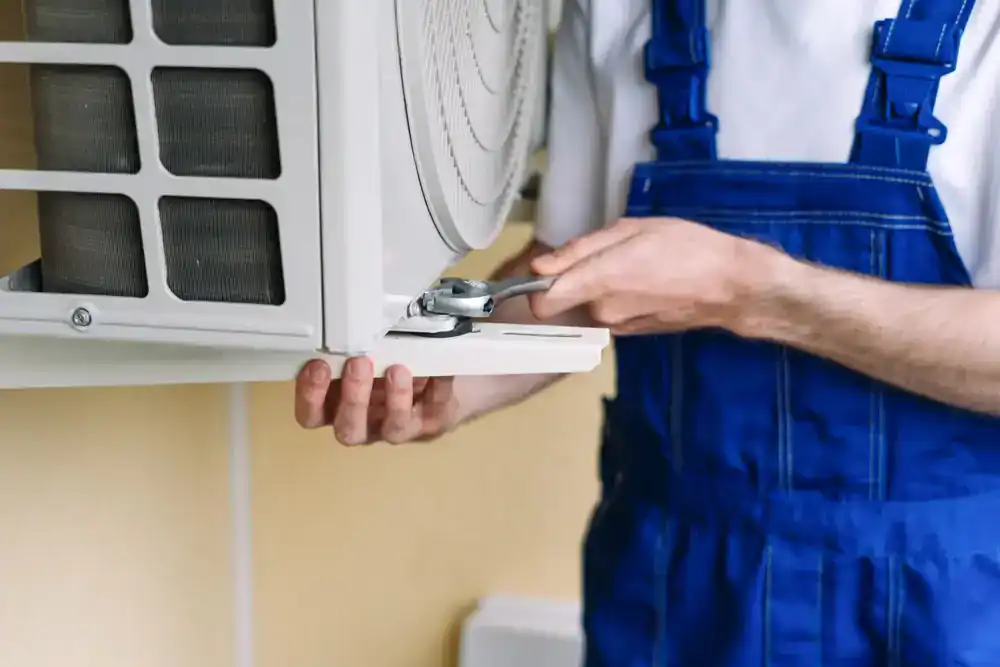
Wall sleeve integrity is another maintenance item that gets overlooked. The sleeve is the metal liner in the wall that the PTAC unit slides into. Over time, the seals around the sleeve degrade, allowing outside air and moisture to infiltrate around the unit. In New York County winters, that means cold air leaking into the room. In summer, it means humidity. Inspecting and resealing wall sleeves is a routine part of professional PTAC maintenance that most building managers don’t know to ask for.
PTAC vs. Central Air: What Would It Actually Cost to Switch in a Manhattan Building?
This is the question that usually ends the conversation. Converting an existing New York County building from PTAC units to central air is not a straightforward upgrade — it’s a construction project. Buildings that weren’t designed with ductwork require mechanical rooms, new duct runs or piping throughout the structure, and often electrical service upgrades to handle the load. In most cases, it also means significant disruption to occupied spaces.
The cost ranges from $20,000 to $50,000 or more per unit — and in this context, “unit” means per apartment or hotel room, not per HVAC unit. For a 100-room hotel in Midtown, you’re looking at a potential outlay of $2 million to $5 million, minimum, before accounting for construction overruns, permit costs, and lost revenue during the work. That number tends to put the cost of maintaining and repairing PTAC units in a very different light.
There’s also an efficiency argument that often gets lost in the central air conversation. Central air systems that run through ductwork lose a meaningful portion of their conditioned air — sometimes close to a third — through duct leakage before it ever reaches the room. PTAC units deliver conditioned air directly into the space they’re serving, with no distribution losses. In individual room applications, a modern PTAC unit with an EER rating of 10 to 13 is genuinely competitive with central air, especially when you account for the inefficiencies of a retrofitted duct system in a building that wasn’t designed for it.
For buildings in New York County that are subject to Local Law 97 — the city’s building emissions law that applies to properties over 25,000 square feet — upgrading to high-efficiency PTAC units (EER 12.0 or higher) is a real compliance pathway. These units meet LEED criteria and directly reduce a building’s carbon footprint. That’s a meaningful consideration for commercial property owners facing escalating penalties through 2030. Switching to central air doesn’t automatically solve a Local Law 97 problem — and in many cases, the construction disruption of a central air conversion creates more regulatory complexity, not less.
The honest conclusion: for the vast majority of existing commercial buildings in New York County, PTAC repair and maintenance isn’t a compromise. It’s the architecturally and economically correct decision. Central air makes sense when you’re building from scratch or doing a complete gut renovation. For everything else, keeping your PTAC system in good shape — with the right parts, the right technicians, and a consistent maintenance schedule — is the smarter path.
Who to Call for PTAC Repair and Maintenance in New York County
If your building runs on PTAC units — and most commercial buildings in New York County do — the quality of your service provider matters more than most people realize. The difference between a technician who knows these systems and one who doesn’t shows up in the repair, in the parts used, and in how long the fix actually holds.
We’ve been supplying and servicing PTAC units in the New York metro area for over 50 years. We carry more than 20,000 OEM parts, we specialize in hard-to-find components for older and discontinued units, and our technicians are available around the clock for emergencies. Whether you need a single unit repaired, a full building maintenance plan, or honest guidance on whether repair or replacement makes more sense for your situation — we’re the call worth making first.