Summary:
You already know your HVAC system needs maintenance. What you might not know is how fast the cost of skipping it adds up — or how different the math looks when you’re managing a building in New York County versus anywhere else in the country.
New York County’s heat island effect, aging building stock, and Local Law compliance deadlines make commercial AC maintenance a different conversation here than it is in the suburbs. This guide walks through what a real maintenance program looks like, what the numbers say about doing it right, and what to watch for when your current setup isn’t cutting it.
What Commercial Air Conditioner Maintenance Actually Includes
There’s a version of “maintenance” that’s just someone showing up, swapping a filter, and handing you an invoice. That’s not what we’re talking about here.
Real commercial air conditioner maintenance is systematic. It follows a schedule tied to how hard your system is working, what season is coming, and what the equipment’s history looks like. Done right, it catches the problems that don’t announce themselves — the refrigerant that’s running slightly low, the coil buildup that’s quietly forcing your compressor to work 30% harder, the condensate drain that’s one humid afternoon away from a ceiling leak.
For most commercial buildings in New York County, that means a combination of monthly checks your building staff can handle, quarterly inspections by a licensed technician, and a thorough semi-annual service visit before summer and before winter.
Commercial AC Unit Maintenance: What Each Service Visit Should Cover
A lot of property managers don’t actually know what they’re paying for when a technician visits. That’s worth fixing, because if you don’t know what a thorough visit looks like, you can’t tell the difference between one and a rushed walk-through.
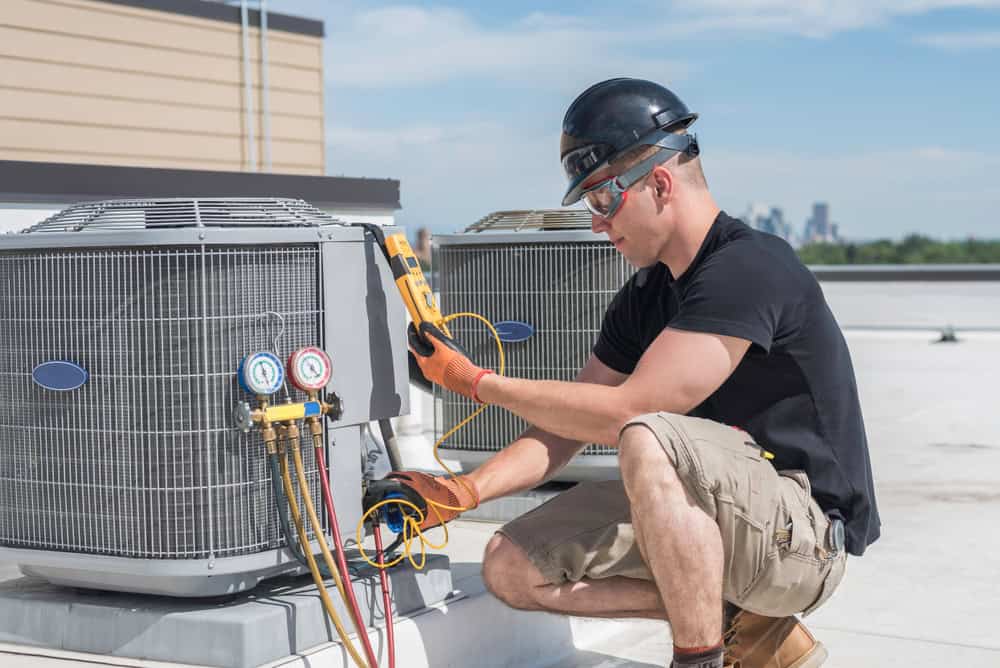
At a minimum, a proper commercial AC unit maintenance visit should include a full inspection and cleaning of the evaporator and condenser coils, a refrigerant level check, electrical connection tightening, thermostat calibration, and a review of the condensate drain and drain pan. Filters should be replaced on a schedule — in commercial buildings, that’s typically every two to three months, not once a year. Blower motors, belts, and bearings need lubrication. If your system has a water loop — common in New York County high-rises running water source heat pumps — the loop pressure and temperature differentials should be checked as well.
The DOE has documented that organizations following structured operations and maintenance practices save between 5% and 20% annually on energy costs. For a commercial building spending $100,000 a year on HVAC energy, that’s a real number. And that’s before you factor in the avoided repair costs.
Here’s what the deferred maintenance version looks like in practice: a system that should last 15 to 20 years starts failing at 9 to 12. A compressor that could have been saved with a $300 service call becomes a $6,000 replacement. An unplanned shutdown in August — the kind that sends tenants to hotels and triggers complaints to the board — costs an average of $12,800 when you add up the emergency contractor premiums, temporary cooling rentals, and tenant disruption. That figure comes up repeatedly in commercial property management research, and it’s consistent with what we see in the field.
The maintenance contract that feels like an expense line is almost always cheaper than the alternative.
Maintaining Older HVAC Systems in New York County's Pre-War and Mid-Century Buildings
This is where a lot of generic HVAC guides fall short. They’re written for newer systems in newer buildings, and they don’t address what’s actually running in a significant portion of New York County’s commercial and residential building stock.
If you manage a pre-war or mid-century building in New York County — and there are thousands of them — your HVAC infrastructure is different. The duct configurations are non-standard. The mechanical room space is limited. And the equipment may be running on components that most distributors stopped stocking years ago. When a technician tells you that you need to replace the whole unit because they can’t find the part, that’s often a sourcing problem, not an engineering one.
We’ve been working with New York County’s older building stock since 1964. That’s not a throwaway line — it means our technicians have worked on systems that were installed before most of today’s property managers entered the industry. We understand the specific failure patterns of legacy PTAC units, older water source heat pump loops, and fan coil systems that have been running in the same building for 30 or 40 years.
We’ve also built an inventory of over 20,000 parts specifically because this problem is real. OEM components for discontinued models, hard-to-find replacement parts for legacy systems, the specific capacitor or control board that a generalist contractor would give up on sourcing — that’s what we’ve built our parts operation around. When we say “if our Smart Parts Team can’t get it for you, no one can,” that’s the product of six decades of working in this market.
The difference between a building that runs well and one that’s constantly in reactive mode often comes down to whether the people maintaining it actually know the equipment. Not just the new stuff — all of it.
Central Air Maintenance for Large Commercial Buildings in New York County
Buildings running centralized HVAC — air handlers, chillers, cooling towers, and extensive duct networks — have a more complex maintenance picture than those running individual PTAC or fan coil units. The scale is different, the failure consequences are larger, and the regulatory environment adds another layer.
In New York County, if your building is over 50,000 square feet, Local Law 87 requires an energy audit and retro-commissioning of your base building systems — including HVAC — every ten years. Local Law 97 sets carbon emissions performance standards for buildings over 25,000 square feet, with financial penalties for non-compliance. A poorly maintained central air system doesn’t just cost you in energy and repairs — it can cost you in fines.
How Often Should Central Air Be Serviced in a Commercial Building?
The honest answer is: more often than most buildings are doing it. The standard recommendation for commercial central air maintenance is semi-annual — a full inspection and service visit in the spring before cooling season, and again in the fall before heating season. High-occupancy buildings, those with 24-hour operations, or buildings with aging equipment often need quarterly attention.
New York County’s climate makes the case for staying on the aggressive end of that schedule. The urban heat island effect is real and measurable — the density of buildings, pavement, and human activity in New York County raises ambient temperatures 2 to 7 degrees above surrounding areas. Your rooftop units and air-cooled condensers are working in that elevated heat environment all summer. That accelerates wear on compressors and coils in ways that a building in a less dense market simply doesn’t experience at the same rate.
Spring is the critical window. April and May are when you want a full system inspection completed — coil cleaning, refrigerant verification, electrical checks, duct inspection for leaks, and a performance test before the first heat wave hits. Property managers who call us in July because something failed are almost always the ones who pushed the spring visit to “when things slow down.” Things don’t slow down. Schedule it early.
For the fall visit, the focus shifts to preparing the system for heating demand, winterizing cooling-only components, and handling any deferred repairs while tenant comfort isn’t at stake. It’s also the right time for major component replacements if the spring inspection flagged anything significant — you have more scheduling flexibility in October than you do in August.
If your building is approaching a Local Law 87 compliance deadline, the retro-commissioning process will require documentation of your HVAC system’s current performance. A well-maintained system with service records is significantly easier — and cheaper — to bring into compliance than one that’s been running on deferred maintenance for years.
PTAC and WSHP Maintenance: What New York County Buildings Actually Need
PTAC units and water source heat pumps are the dominant HVAC systems in New York County’s hotels, co-ops, condos, and many commercial buildings. If you’re managing a building with 100, 200, or 300 individual PTAC units, you already know that the maintenance picture is different from a single central air system — it’s a numbers game, and deferred maintenance on individual units compounds fast.
PTAC maintenance isn’t complicated, but it does require consistency. Filters need to be cleaned or replaced regularly — in a high-occupancy building, that’s every one to three months depending on the unit and the environment. Coils need to be cleaned annually at minimum; in New York County’s air quality environment, more often. The chassis seal and sleeve condition should be checked to prevent water infiltration, which is a common and destructive failure mode in older PTAC installations. Drainage needs to be clear. Thermostats and controls should be tested to make sure the unit is actually delivering the temperature it’s set to — a unit that’s running but not conditioning properly is wasting energy and generating complaints.
Water source heat pump systems add the loop to the equation. The water loop that connects WSHP units throughout a building needs its own maintenance program: loop pressure monitoring, water treatment to prevent scale and biological growth, pump and heat exchanger inspection, and periodic flushing. A loop problem doesn’t affect one unit — it affects every unit connected to it. That’s why WSHP maintenance requires someone who understands the system as a whole, not just the individual units.
We carry an extensive inventory of PTAC and WSHP parts — including OEM components for systems that have been running in New York County buildings for decades. When a unit needs a part that most contractors would have to wait weeks to source, we can usually move same day from our Long Island City warehouse, which is minutes from New York County across the Queensboro Bridge. That proximity matters when a hotel has guests in the rooms or a co-op board is waiting for a resolution.
Finding the Right Commercial AC Maintenance Partner in New York County
The through-line in all of this is pretty simple: the buildings that run well are the ones where maintenance is treated as a system, not an afterthought. Consistent service visits, a technician who actually knows your equipment, and a parts supply chain that doesn’t leave you waiting three weeks for a repair — those are the things that keep a New York County commercial building out of crisis mode.
If you’re managing a building in New York County and your current maintenance program feels more reactive than preventive, or if you’ve been told a system needs full replacement when you’re not sure that’s actually true, it’s worth getting a second opinion from someone who’s been working in this market for a long time.
We’ve been doing exactly that since 1964 — for hospitals, hotels, co-ops, schools, and commercial real estate organizations across the tri-state area. If you want to talk through what your building actually needs, we’re here for it.