Summary:
You’re trying to figure out whether a ductless mini split or central air makes more sense for your New York County property. The pricing you’re finding online ranges from $3,000 to $15,000, and nobody’s explaining why the spread is so wide.
Here’s what actually drives the cost difference: ductwork. If your Manhattan building doesn’t have it, adding ducts for central air can double your project budget. If you already have ducts in good shape, central air might cost less upfront than a multi-zone mini split system.
But installation cost isn’t the full story. Energy efficiency, zoning flexibility, available NYSERDA rebates, and how each system fits your building’s layout all affect what you’ll actually spend over the next 15 years. Let’s break down what mini split and central air systems actually cost in Manhattan, what makes one cheaper than the other, and how to choose the system that fits your property and budget.
Mini Split vs Central Air
Mini split systems—also called ductless mini splits—deliver heating and cooling without ductwork. You’ve got an outdoor compressor unit connected to one or more indoor air handlers mounted on walls or ceilings. Each indoor unit cools or heats a specific zone, and you control each one independently.
Central air systems push conditioned air through ductwork installed in your walls, floors, or ceilings. One indoor unit connects to ducts throughout your building, distributing air to every room through vents. You control the whole system from a single thermostat.
The fundamental difference is how air gets delivered. Ductless systems send it directly into each room. Central air routes it through hidden ducts. That difference shapes everything else—installation complexity, upfront cost, energy efficiency, and which buildings each system actually works in.
Mini Split Pros and Cons
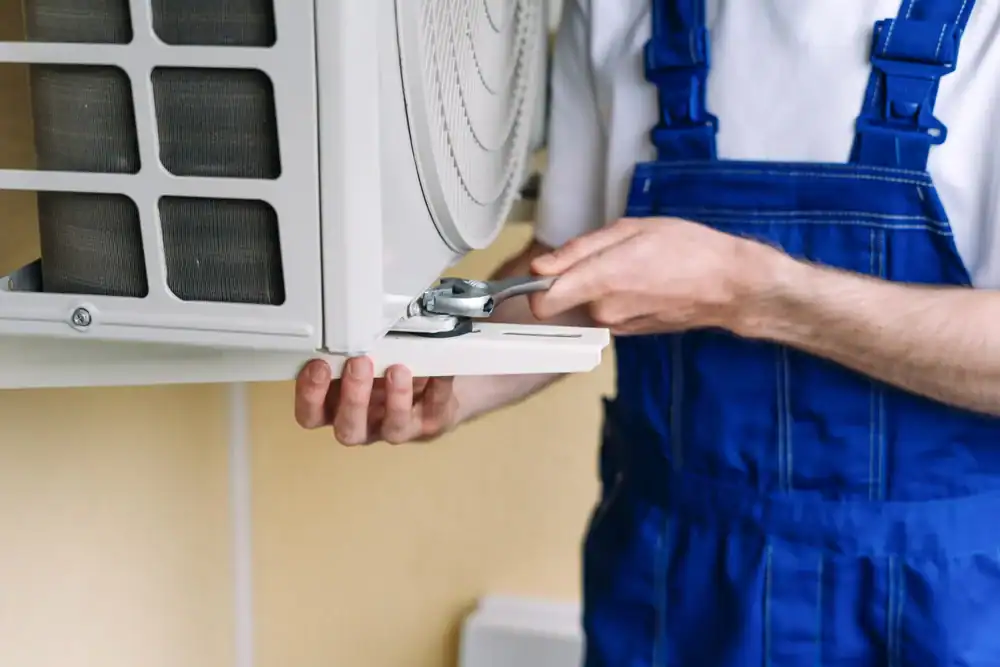
Ductless mini splits excel in buildings without existing ductwork. Installing new ducts in a Manhattan brownstone or pre-war co-op means cutting into walls, ceilings, and floors—expensive, disruptive, and sometimes structurally impossible. Mini splits avoid all of that. Your installer drills a small hole (typically 3 inches) through the wall to connect the indoor and outdoor units with refrigerant lines and electrical wiring, and you’re done. No major construction, no displaced tenants, no replastering walls.
Energy efficiency is another major advantage. Mini splits typically hit 20 to 30 SEER2 ratings, compared to 14 to 20 SEER2 for central air systems. Higher efficiency means lower operating costs every month. You’re also not losing conditioned air through leaky ductwork—the Department of Energy estimates that the average ducted system loses 20 to 30 percent of its output through duct leaks and poor insulation. Ductless mini splits deliver air directly into the room, so you’re not paying to cool your walls and ceiling cavities.
Zoning control gives you flexibility central air can’t match without expensive modifications. Each indoor unit operates independently with its own thermostat or remote control. You can keep your bedroom at 68 degrees while the living room stays at 72. When you’re not using a room, turn that unit down or off entirely. You’re not wasting energy heating or cooling empty spaces, which can cut your monthly bills by 20 to 30 percent compared to a single-zone central system running throughout your entire building.
Modern cold-climate heat pumps—the type used in most mini split systems—provide both heating and cooling. That means you’re replacing two systems (air conditioning and heating) with one piece of equipment. In New York County, where NYSERDA offers rebates up to $10,000 to $12,000 for qualifying heat pump installations, the economics can shift dramatically in favor of mini splits even when upfront costs run higher.
The downsides are visibility and maintenance. Indoor units are mounted on your walls or ceilings, typically 7 to 8 feet off the floor, and they’re noticeable. Some people don’t mind the look. Others find it disruptive, especially in spaces where aesthetics matter. Central air hides everything behind vents. Maintenance is also more involved with ductless systems because you’ve got multiple indoor units to service instead of one central air handler. Filters need cleaning monthly, and annual professional maintenance costs more when you’re servicing three or four units instead of one.
Upfront cost for whole-home mini split systems can run higher than central air if you already have ductwork. A multi-zone setup covering three or four rooms in New York County typically costs $8,000 to $15,000 installed. If your building already has ducts in good condition, central air might come in at $5,000 to $12,500. But if you need to install ductwork from scratch, that calculation flips entirely. Add $2,000 to $10,000 for duct installation, and suddenly central air costs significantly more than a comparable ductless system.
Not every room needs the same BTU capacity. A 350-square-foot bedroom might only need a 9,000 BTU indoor unit, while a 1,000-square-foot living area requires an 18,000 BTU or 24,000 BTU unit. Your HVAC contractor calculates the right capacity based on room size, insulation levels, window area, ceiling height, and sun exposure. Getting this right matters—undersized units can’t keep up on hot summer days, and oversized units cycle on and off inefficiently.
What Is Central Air Conditioning
Central air conditioning uses a single indoor unit—usually installed in a basement, utility closet, or mechanical room—to cool air and distribute it through ductwork. The indoor unit contains an evaporator coil and a blower fan powerful enough to push conditioned air through ducts running behind your walls, above ceilings, or below floors. Vents in each room deliver the cooled air. The system connects to an outdoor condenser unit that releases heat removed from your indoor air.
The main advantage is convenience. One thermostat controls your entire building. You set it to 72 degrees, and every room gets cooled to that temperature. There’s no managing multiple units or remembering to adjust settings in different zones. For people who want simple, whole-home comfort without thinking about it, central air delivers exactly that.
Central air is also less visible inside your living space. The indoor air handler stays hidden in a basement, closet, or mechanical room. You see vents in each room, but they’re small and unobtrusive compared to wall-mounted mini split units. If aesthetics matter and you don’t want HVAC equipment on display, central air keeps everything out of sight. Many Manhattan co-ops and condos prefer this approach for maintaining clean interior design.
Maintenance is simpler with central air because you’ve got one indoor unit to service instead of multiple mini split heads. Your HVAC technician changes one filter, checks one evaporator coil, inspects one blower fan, and tests refrigerant levels at one location. It’s faster and typically costs less than servicing a multi-zone ductless system spread across three or four rooms.
The problem is ductwork. If your building doesn’t have it, installing ducts is expensive and disruptive. You’re looking at $2,000 to $10,000 just for the ductwork in a typical Manhattan property, depending on building layout and how much cutting into walls and ceilings is required. Older buildings with plaster walls, tight spaces, or historic preservation restrictions can push duct installation costs even higher. And if your ducts are old and leaky, you’re losing 20 to 30 percent of your cooled air before it even reaches the rooms you’re trying to cool. That’s money literally disappearing into your walls.
Energy efficiency with central air depends heavily on duct condition. Even a high-efficiency system rated at 18 SEER2 loses effectiveness if your ducts are poorly insulated or full of leaks. In practice, many central air systems deliver far less cooling per dollar spent on electricity than their SEER rating suggests, simply because so much conditioned air escapes through the ductwork before reaching your living space.
Central air also lacks zoning flexibility unless you invest in a zoned system with motorized dampers and multiple thermostats. Standard central air treats your entire building as one zone. If your bedroom is too cold and your living room is too warm, you’re stuck adjusting the whole system and hoping it balances out. You’re also cooling or heating every room all the time, even spaces you’re not using, which wastes energy. Adding zoning to a central air system costs $2,000 to $5,000 or more, which narrows the cost advantage over ductless mini splits.
For buildings that already have well-maintained ductwork and need straightforward whole-home cooling, central air makes sense. For Manhattan properties without ducts—or with ducts in poor condition—the economics rarely favor central air once you factor in the cost of duct installation or repair.
Central Air vs Mini Split Cost
Installation cost in New York County depends on whether you already have ductwork. If your building has ducts in good condition, central air typically costs $5,000 to $12,500 installed. That includes the outdoor condenser, indoor air handler, refrigerant lines, electrical work, and labor. You’re replacing equipment that connects to infrastructure already in place.
Ductless mini split systems for a single zone—one outdoor unit and one indoor air handler—cost $3,000 to $5,000 installed in Manhattan. If you’re only cooling one room or a small space, mini splits come in cheaper than central air. But whole-home mini split systems with multiple indoor units cost $8,000 to $15,000, which can run higher than central air if you’ve already got ductwork.
The calculation flips entirely if you don’t have ductwork. Installing new ducts adds $2,000 to $10,000 to your central air project, depending on your building’s layout and how difficult it is to run ductwork through walls and ceilings. Older Manhattan buildings with plaster walls, tight spaces, or structural constraints can push duct installation costs toward the high end of that range or beyond. When you factor in ductwork, ductless mini splits almost always cost less.
How Much Does Mini Split Installation Cost
Mini split installation cost in New York County breaks down by zones and BTU capacity. A single-zone system—one outdoor unit and one indoor air handler—runs $3,000 to $5,000 installed. That price includes the equipment, refrigerant lines, electrical connections, wall penetration, mounting hardware, and labor.
Multi-zone systems cost more because you’re adding indoor units. Two zones typically run $5,000 to $8,000. Three zones cost $8,000 to $12,000. Four zones can reach $12,000 to $15,000 or more. Each additional indoor unit adds roughly $1,500 to $3,000 to your total, depending on the unit’s BTU capacity, mounting location, and refrigerant line length required.
Labor costs in Manhattan are higher than most other markets. HVAC technicians in New York County charge $1,000 to $2,000 for single-zone installations and $2,000 to $4,000 for multi-zone systems. That’s 15 to 44 percent above the national average, driven by higher cost of living, stricter licensing requirements, and the logistical challenges of working in dense urban buildings. If your building requires crane access to lift equipment to a rooftop, add another $2,000 to $5,000. Manhattan projects typically cost 10 to 20 percent more than installations in Brooklyn or Queens due to tighter building access and coordination requirements with building management.
Permits in New York County cost $200 to $500 for mini split installations. Your contractor typically handles the permit process, but it’s worth confirming that permit fees are included in your quote. Some contractors list permits as a separate line item, while others roll them into the total project cost.
Electrical work can add $500 to $2,000 if your building needs a new 240V dedicated circuit or panel upgrades to support the mini split system. Older buildings with outdated electrical panels often require this work. Your HVAC contractor should assess your electrical setup during the initial consultation and let you know if upgrades are needed before providing a final quote.
BTU capacity affects equipment cost significantly. A 9,000 BTU single-zone unit costs less than an 18,000 BTU or 24,000 BTU unit. Larger spaces require higher BTU capacity, which means more expensive equipment. Your contractor will calculate the right BTU capacity based on your room size, insulation quality, window area, ceiling height, and sun exposure. Undersizing saves money upfront but leaves you with a system that can’t keep up on hot days. Oversizing wastes money on equipment capacity you don’t need and causes the system to cycle on and off inefficiently.
Brand choice also affects cost and long-term value. Premium brands like Mitsubishi, Daikin, Fujitsu, and Carrier cost more than budget brands, but they typically offer better warranties (up to 12 years on compressors), quieter operation, and longer lifespan. Cheaper units might save $500 to $1,000 upfront, but if they fail after seven years instead of lasting fifteen, you’re not actually saving money. You’re buying the system twice.
NYSERDA rebates through the Clean Heat program can offset mini split installation costs by $5,000 to $12,000 for qualifying heat pump systems, depending on your utility provider and whether you’re decommissioning fossil fuel heating equipment. Con Edison offers additional rebates of $500 to $1,000 for ENERGY STAR-rated ductless mini splits. Combined, these incentives can reduce your net cost by $6,000 to $13,000 or more, which dramatically changes the economics compared to central air. Working with a participating contractor who understands the rebate process ensures you actually capture these savings instead of leaving money on the table.
How Much Does Central Air Installation Cost
Central air installation in New York County costs $5,000 to $12,500 when you already have ductwork in place. That includes the outdoor condenser unit, indoor air handler, refrigerant lines, electrical connections, thermostat, and labor. The price range depends on system size (measured in tons), efficiency rating (SEER2), and whether you’re doing a straightforward equipment swap or making modifications to your existing setup.
System size drives equipment cost. A 2-ton system for a smaller apartment might cost $3,500 to $6,000 for the equipment alone. A 5-ton system for a larger property can run $6,000 to $12,000 or more. Your contractor determines the right size based on your building’s square footage, insulation quality, window area, and cooling load calculations. Bigger isn’t always better—an oversized system cycles on and off too frequently, which wastes energy and wears out components faster. An undersized system runs constantly and never quite keeps up on the hottest days.
Efficiency ratings affect both equipment cost and long-term operating costs. A basic 14 SEER2 system costs less upfront than a high-efficiency 20 SEER2 model, but the more efficient system saves money every month on your electric bill. In New York County, where electricity rates run higher than the national average at around 23 cents per kWh, that monthly savings adds up quickly. A high-efficiency system might cost $2,000 more upfront but save $300 to $500 per year in operating costs, paying for itself in four to six years and continuing to save money for the rest of its 15 to 20 year lifespan.
Labor for central air installation in Manhattan runs $3,000 to $8,000 or more, depending on project complexity. A simple equipment swap in a building with good ductwork and easy access takes less time than a project requiring duct modifications, new refrigerant lines, or difficult equipment placement. Manhattan projects typically cost 10 to 20 percent more than installations in Brooklyn or Queens due to tighter building access, stricter building management requirements, longer equipment delivery times, and the need to coordinate with doormen, building managers, and co-op boards.
Ductwork is the wild card that makes or breaks central air economics. If your building doesn’t have ducts, installing them adds $2,000 to $10,000 to your project cost. Simple duct runs in a straightforward layout might come in at the low end. Complex installations in older buildings with plaster walls, tight spaces, or structural obstacles can push costs toward the high end or beyond. Some buildings simply can’t accommodate ductwork without major structural modifications, which makes central air impractical regardless of cost.
If your existing ductwork is old, leaky, or undersized, you might need duct repairs or replacement even if ducts are already present. Sealing leaks and adding insulation costs $1,000 to $3,000. Replacing sections of ductwork costs $2,000 to $5,000 or more, depending on how much needs replacement. Skipping necessary duct repairs means you’re installing a new, efficient system that loses 20 to 30 percent of its output through leaky ducts—wasting money every month and never achieving the comfort or efficiency you paid for.
Permits, electrical work, and other costs follow similar ranges to mini split installations. Budget $200 to $500 for permits and $500 to $2,000 for electrical upgrades if your building needs panel work or a new dedicated circuit. Thermostat upgrades, zone dampers for multi-zone systems, or smart controls add another $200 to $1,500 depending on what you choose and how many zones you’re creating.
The total cost picture for central air looks favorable when you’ve got good ductwork and need straightforward whole-home cooling. It looks significantly less attractive when ductwork needs installation or major repairs. That’s why understanding your building’s existing infrastructure is the first step in making a smart decision about which system to install.
Which HVAC System Is Right for Your Property
The right system depends on your building’s existing infrastructure and how you actually use the space. If you’ve got ductwork in good condition and you want whole-home comfort controlled from a single thermostat, central air delivers that convenience at a lower upfront cost than a multi-zone ductless mini split system.
If your building doesn’t have ductwork, mini splits almost always make more financial sense. You’re avoiding $2,000 to $10,000 in duct installation costs, and you’re getting higher energy efficiency and zoning flexibility. For Manhattan properties—especially brownstones, co-ops, and older buildings without existing ducts—ductless mini splits solve problems that central air creates.
Operating costs over 15 years often favor mini splits even when central air costs less upfront. Higher efficiency ratings (20 to 30 SEER2 vs 14 to 20 SEER2) and the ability to cool only the rooms you’re using can save 20 to 30 percent on monthly energy bills. That adds up to thousands of dollars over the system’s lifespan. Factor in NYSERDA rebates of $5,000 to $12,000 for qualifying heat pump systems, and the net cost difference between systems narrows considerably or disappears entirely.
The best way to know what makes sense for your specific property is to talk to someone who understands both systems and can evaluate your building’s layout, existing infrastructure, and cooling needs without pushing you toward whichever system pays the highest commission. We’ve been helping New York County property owners make these decisions for over 50 years, with the technical knowledge to recommend the right system and access to 20,000+ parts and all major brands to support whatever you choose.